China’s wet pet food sector is gaining attention as owners seek higher palatability, hydration, and ingredient transparency. The APPA 2024 State of the Industry Report valued the United States pet industry at approximately $152 billion in 2024. Pet food and treats represented about $65.8 billion. This spending signals strong demand, but market size alone cannot prove nutritional superiority.
Why is wet food better than dry for some pets? Its high moisture content can support cats and dogs that drink little. It may also help older animals with dental discomfort or reduced appetite. Typical wet products contain roughly 70%–80% moisture, while many dry diets contain about 8%–12%. These figures come from common product formulations and labeling standards, not universal rules. Some pets thrive on dry food. Others need a mixed feeding plan.
Veterinary guidance matters here. The World Small Animal Veterinary Association recommends evaluating complete nutrition, life stage, body condition, and individual health needs. Therefore, this China Top 10 supplier overview will examine more than price. It will consider factory audits, ingredient traceability, HACCP systems, export experience, laboratory testing, and compliance with destination-market requirements. Supplier claims still require verification. That part is easy to overlook.
The comparison is not perfectly clean. A premium dry diet may outperform a poorly formulated wet product. Even attractive packaging can hide weak formulation. Reliable suppliers should provide clear guaranteed analysis, feeding directions, batch records, and evidence of nutritional adequacy. These practical details help buyers separate genuine manufacturing strength from convenient marketing language.
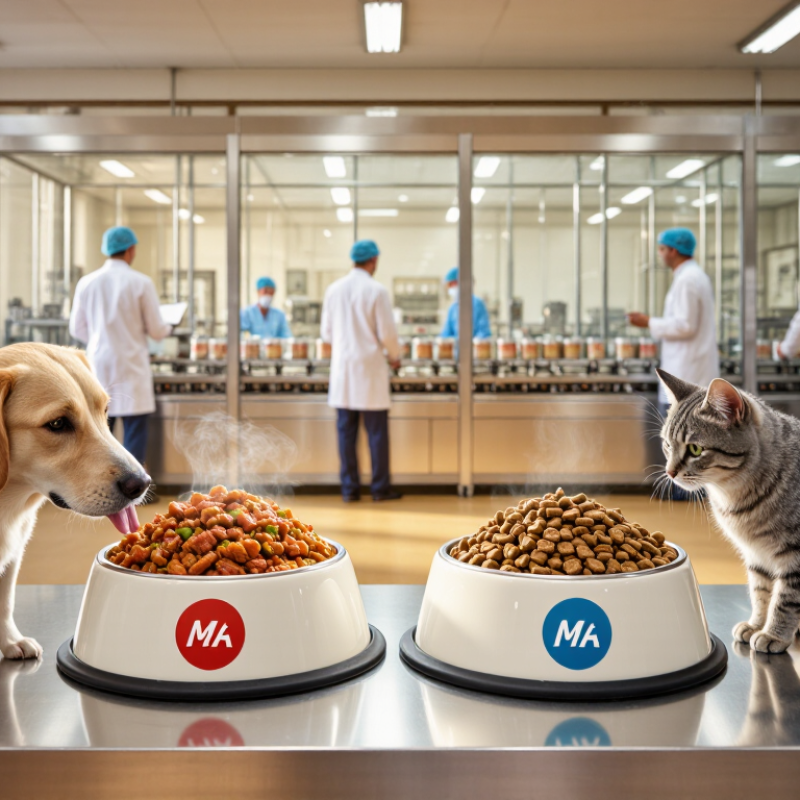
Wet pet food is a cooked meal sealed in cans, trays, or pouches. It usually contains 70–85% moisture, while dry food often contains about 8–12%. This difference changes feeding, storage, and texture. Wet recipes may include meat pieces, broth, organs, vegetables, and measured vitamins. The high moisture can support daily water intake, especially for pets that rarely drink from a bowl. It also creates a stronger aroma and softer bite. Helpful for some older pets.
Dry food is baked or extruded into small pieces. Its lower moisture makes it lighter, easier to measure, and simpler to store after opening. It also provides more calories in a smaller serving. However, dry texture does not reliably clean teeth, despite a common assumption. Wet food can spoil faster once opened, so unused portions need refrigeration and careful handling. It can also cost more per feeding because water adds weight.
Reliable suppliers should show ingredient traceability, batch testing, controlled cooking temperatures, and clear nutritional analysis. Sealed packaging reduces contamination risks, but it cannot fix poor formulation. “Better” depends on the pet’s age, health, appetite, and drinking habits. A mixed feeding plan may work well, although portion calculations are easy to get wrong. Veterinary guidance remains sensible for pets with kidney, urinary, or digestive concerns.
Wet pet food usually contains far more moisture than dry kibble, often supporting daily fluid intake. This can benefit cats and dogs that drink very little. That matters daily. Cats, in particular, may have a weaker thirst response than expected. Adding moisture may help maintain healthier urine concentration and smoother digestion. However, wet food cannot replace fresh water or professional veterinary care.
Its nutritional value depends on the recipe, not its texture alone. Complete formulas can provide animal-based protein, essential fats, vitamins, and minerals in balanced amounts. The soft texture may also help older pets or animals with dental discomfort eat more comfortably. Still, some wet foods are only supplemental diets. Labels deserve patience. Buyers should check nutritional adequacy, ingredient consistency, manufacturing controls, batch testing, and traceability when evaluating suppliers in China’s pet food market.
Practical handling affects safety. Introduce a new formula gradually over several days. Refrigerate opened containers and discard food left at room temperature for too long. Caregivers often notice better appetite after switching to wet food, but weight gain can follow if portions are not adjusted. I would question any supplier promising universal benefits. Individual age, activity, allergies, and medical history matter. A veterinarian can help match moisture, calories, and nutrients to the pet’s actual needs.
Evaluating China’s top wet pet food suppliers requires more than comparing prices or catalog photos.
Mordor Intelligence estimates China’s pet food market will maintain strong growth through 2030. This demand increases supplier competition, but also increases quality differences. Ask each supplier for factory ownership details, production capacity, HACCP or ISO 22000 evidence, and recent third-party test reports. Confirm whether the certificate covers the actual production site.
Product quality needs practical verification.
Request complete ingredient specifications, guaranteed analysis, taurine levels, moisture data, and shelf-life testing. A reliable supplier should provide batch traceability from raw material receipt to finished cans or pouches. Check the filling weight, seal strength, sterilization records, and storage conditions.
Small details matter. A swollen pouch is not a minor inconvenience.
Euromonitor’s pet care research consistently identifies premiumization as a major growth trend, especially in functional and high-meat products.
Therefore, evaluate whether claims match laboratory evidence. Compare several samples through independent palatability trials, not one office tasting. Ask for production samples from different batches. The first sample may be unusually good. I would also review complaint rates, replacement policies, and response speed. A low quotation can look attractive, but cheaper packaging or unstable formulas may create higher long-term costs.
No checklist replaces an on-site audit, and remote verification can miss uncomfortable realities.
China Top 10 Wet Pet Food Suppliers: Why Better Than Dry?
China’s top ten wet pet food suppliers stand out through different product strengths. Supplier 1 focuses on complete canned meals with stable nutrient ratios. Supplier 2 develops high-meat recipes for cats and small dogs. Supplier 3 offers retort pouches with softer textures and easy portion control. Supplier 4 specializes in low-temperature cooking to protect aroma and moisture. Supplier 5 provides private-label formulas for sensitive digestion. Supplier 6 combines wet food with functional ingredients, such as fiber or joint-support nutrients.
Supplier 7 performs well in customized recipes and flexible minimum order quantities. Supplier 8 uses novel proteins for pets with common food sensitivities. Supplier 9 emphasizes transparent sourcing and batch-level traceability. Supplier 10 produces complementary broths, toppers, and mousse-style foods. These strengths matter because wet food usually supplies more moisture than dry food. It may also support appetite in older pets or animals with low water intake.
Product strength alone is not enough. I would check factory audits, ingredient records, microbiological testing, and packaging integrity before placing an order. A clean sample can still hide inconsistent texture between batches. That deserves attention. Buyers should also verify feeding trials, storage performance, and export documentation. Some suppliers communicate well but provide limited technical evidence. Others have strong laboratories but slower custom development. The best choice depends on pet age, target market, formula purpose, and quality budget.
Category-level comparison of common wet and dry pet food characteristics
Wet pet food typically contains substantially more moisture and fewer calories per 100 g than dry food, which can support hydration and portion control. Dry food generally provides higher energy density and is easier to store. Values shown are representative midpoints of commonly reported commercial product ranges, not company-specific data.
Choosing a Chinese wet pet food supplier requires more than comparing prices. The right partner should understand your target market, product goals, and quality expectations. Ask for a complete ingredient specification, production flow, and recent laboratory reports. Do not accept vague claims about “premium” quality.
Request samples from different batches. Check the texture, aroma, filling weight, and seal condition after storage. A reliable supplier should explain its cooking process, water activity controls, traceability system, and shelf-life testing. Visit the facility when possible. Clean floors, organized raw-material storage, and clear batch records reveal more than polished sales presentations. Still, one visit cannot prove everything.
Discuss minimum order quantities, packaging options, lead times, and response procedures before signing an agreement. Confirm whether the supplier can provide documents required by your destination market. These may include ingredient declarations, health certificates, test reports, and export records. Communication matters too. Slow answers can become costly during a packaging change or shipment delay.
Wet food often offers higher moisture and strong palatability, but it needs careful handling and packaging control. Dry food is easier to transport, yet neither format is automatically better for every pet or market. Choose according to your customers’ needs. I have seen attractive samples fail because the final batch felt different. That risk deserves attention. Ask how complaints are investigated, corrected, and recorded. A supplier that admits limitations may be more dependable than one promising perfection.
Wet food contains more moisture than dry kibble. It may help pets that drink very little, especially some cats. Fresh water remains necessary.
Not automatically. Nutrition depends on the recipe and nutritional balance, not texture alone. Check protein, fats, vitamins, minerals, and feeding adequacy.
Its soft texture may help older pets or animals with dental discomfort. Some pets eat it more readily. Results still vary.
Review ingredient records, factory audits, batch testing, and traceability. Check packaging integrity and microbiological controls. A pleasant sample proves little.
No. Some products are supplemental foods, broths, toppers, or treats. Read the feeding statement carefully before replacing regular meals.
Introduce it gradually over several days. Mix increasing amounts with the familiar food. A sudden switch may upset digestion.
Refrigerate opened containers promptly. Discard food left at room temperature too long. Clean storage matters.
It can if portions are not adjusted. Compare calories, activity, age, and body condition. Appetite may improve, but calories still count.
Confirm minimum order quantities, recipe details, storage performance, and export documents. Ask for technical evidence, not only confident promises. I would remain cautious.
No. Individual allergies, medical history, age, and activity affect suitability. A veterinarian can match moisture, calories, and nutrients more safely. Wet food is not medical care.
This article explores what wet pet food is, how it differs from dry food, and why many owners consider it a valuable option for cats and dogs. Wet food generally contains higher moisture, a softer texture, and a strong aroma, which may support hydration, appetite, and easier chewing. The question “Why is wet food better than dry for some pets” depends on individual needs, including age, dental condition, activity level, eating preferences, and health requirements. Wet food can be especially useful for pets that drink little water or need a more palatable diet, although balanced nutrition remains essential.
The guide also explains how to evaluate China’s top wet pet food suppliers by examining ingredient quality, nutritional formulation, production standards, testing systems, packaging, customization capacity, and supply reliability. It compares ten supplier types according to strengths such as complete meals, specialized formulas, natural ingredients, convenient packaging, and flexible private-label services. Finally, readers will learn how to select a suitable supplier by matching product capabilities, quality expectations, order volume, communication, and long-term cooperation goals.
